When Eligibility Feels Personal: Keeping IEP Decisions Grounded in the Whole Child
There’s a moment in every IEP meeting that carries more weight than almost anything else—
The eligibility decision.
Does this child qualify for special education?
On paper, the answer should be clear.
It should come from the data.
From a comprehensive evaluation.
From a clear understanding of how a child’s disability impacts their education.
And yet—
If you’ve sat at enough IEP tables, you may have felt it too.
Sometimes, the decision doesn’t feel like it’s coming from the data alone.
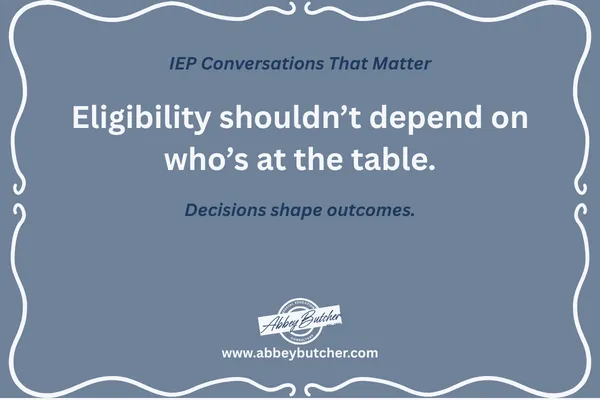
Sometimes, it feels like it’s coming from the people at the table.
When the Same Data Leads to Different Decisions
This is where things get complicated.
Because this isn’t about intent.
IEP teams are made up of people who care deeply about kids.
Who want to do right by them.
Who carry the weight of these decisions long after the meeting ends.
And still—
Two teams can look at similar data and come to different conclusions.
Not because the data changed—
but because the interpretation did.
Because human judgment is part of the process.
And that matters more than we sometimes acknowledge.
What This Feels Like for Parents
For parents, this moment can be incredibly emotional.
It can feel like:
Confusion
Frustration
Disbelief
Feeling dismissed or misunderstood
Because they are walking into a space where:
They are often the last to receive the information
The reports can feel overwhelming or difficult to interpret
Everyone else at the table has training or experience they don’t have
And yet—
They are the only person at that table who knows the child across a lifetime.
They didn’t choose to be at the IEP table.
But they will live with the outcome of that decision every single day.
What This Requires from School Teams
Eligibility is not just a label.
It determines access to support.
It shapes a child’s educational experience.
It can influence long-term outcomes.
Which means—
We have to get this right.
Standardized test scores matter.
But they are only one piece of the picture.
Often gathered in controlled environments, under ideal conditions,
they don’t always reflect how a child experiences their day-to-day learning.
A comprehensive evaluation should go beyond standardized test scores.
It should include multiple sources of data that reflect how a child is actually experiencing school, such as:
Classroom performance
Intervention data
Social and emotional functioning
Input from multiple providers
Observations across settings
Because eligibility decisions are meant to be based on a full and individualized understanding of the child—not a single measure or snapshot in time.
If We Can’t See the Whole Child—We’re Missing Something
By the time an evaluation report is written, the team should have a deep understanding of the child.
Not just their scores—
But how they learn, interact, struggle, compensate, and move through their day.
If a report only includes standardized test scores, it’s incomplete.
If it doesn’t reflect the child’s day-to-day experience, it’s missing something important.
And if a parent reads that report and can’t recognize their child in it—
That’s worth pausing on.
When the Data Doesn’t Quite Add Up
Every now and then, there’s a piece of data that doesn’t fit.
An outlier.
An unexpected result.
A score that doesn’t match what everyone is seeing.
Those moments aren’t something to move past quickly.
They’re an invitation to get curious.
What might be influencing this?
What are we missing?
What else do we need to understand?
Because strong decisions don’t come from ignoring inconsistencies.
They come from investigating them.
The Part We Don’t Talk About Enough
No parent should ever leave an IEP meeting thinking:
If different people had been at the table… would the outcome have been different?
And yet—
That’s a feeling many carry.
Sometimes without even realizing why.
At its core, that’s not aligned with the purpose of special education.
Eligibility decisions are meant to be:
Data-driven
Comprehensive
Consistent
Grounded in the child’s needs
Not dependent on individual interpretation alone.
What Moves This Forward
This isn’t about blame.
It’s about strengthening the process—for everyone.
For school teams, that means:
Looking beyond isolated data points
Connecting multiple sources of information
Ensuring evaluations truly reflect the whole child
For parents, that means:
Asking questions about what’s included—and what’s not
Seeking clarity when something doesn’t feel complete
Sharing what you see outside of the evaluation setting
Because the strongest decisions happen when:
Data is fully understood
Perspectives are shared openly
And the child remains at the center of it all
At the Center of It All
Eligibility is not just a decision.
It’s a doorway.
And how we approach that decision matters.
When we take the time to truly understand the whole child—
to connect the data, the observations, and the lived experience—
We move closer to decisions that feel clear, grounded, and aligned.
Not just for the team in the moment—
But for the child whose path is shaped by what comes next.
If this resonates with you, I’d love to hear your perspective—what has your experience at the eligibility table been like?